
On the early tinkering days and how the honeycomb shade came to be:
Hadley Keller Lloyd: Tell us about those early experimentation days in the seventies, when you were really trying to develop what became the honeycomb shade. How did you first get started down this path?
Wendell Colson: I was an architecture major in college, and when I got out, I wasn't sure I wanted to go to grad school or actually practice architecture, but I knew I really liked building things. My wife and I had bought an old Victorian house outside Boston—a huge, all-encompassing 22-room renovation project. While we waited about a year for permits, I had some time to do research, particularly around energy and energy conservation, which was a big issue at that point.
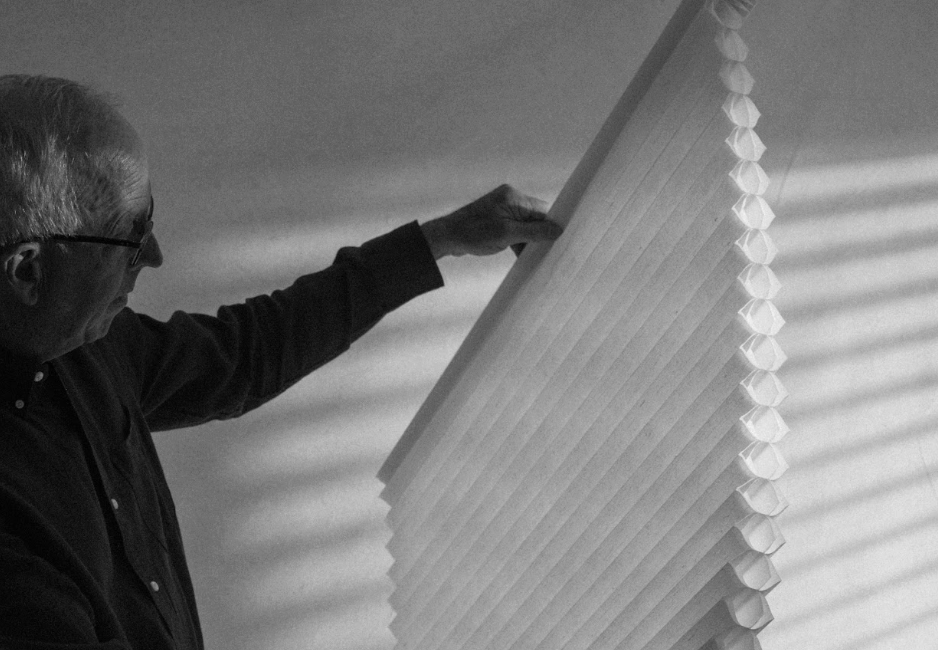
At a home show, I saw a product called a Window Quilt. It was exactly what it sounds like — someone had taken a quilt and mounted it on a roller shade with little tracks that came down to insulate the window. As an architect, I looked at it and thought, he's got the right idea, but this isn't going to fly. So I did some research on insulation, particularly reflective insulation and air cavities, and thought: what if we took something like honeycomb lanterns—though those aren't very pretty—and re-engineered it into something with no creases or glue lines on the outside? Just a single piece, folded.
And then all of a sudden, I realized: oh, that works. And it looked pretty good, too. It was shiny, metalized Mylar, which felt very techy and cool for the time; Mylar space blankets were a big deal back then. I actually called it a "space shade" at first.
Innovation is really key to being a design leader. The act of innovation, done with an eye toward good design, is what leads a company forward as a design leader.
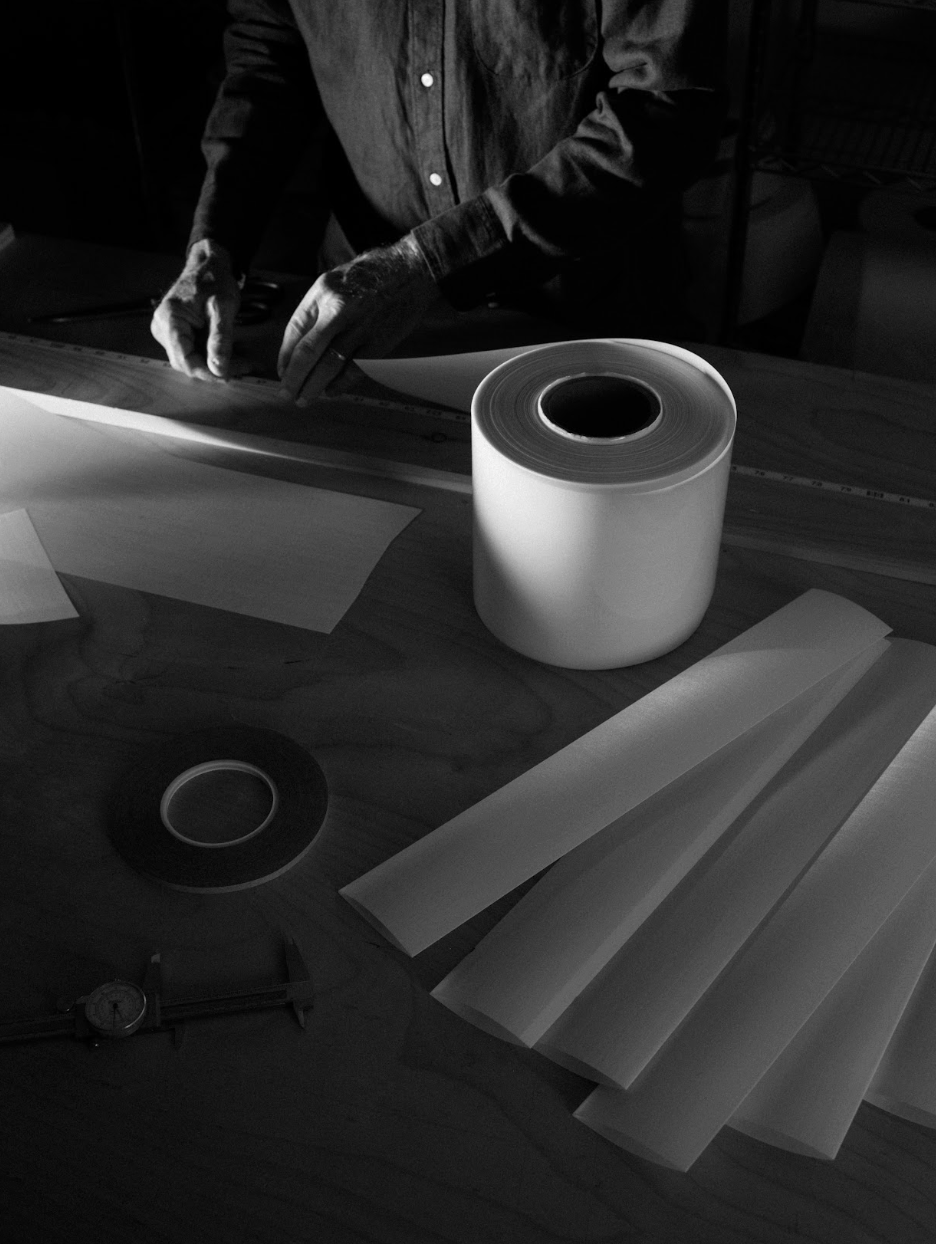
It then took several months to figure out how to actually manufacture it in quantity, because it was really hard to put together—you needed folds in exactly the right place. Eventually I figured out how to make it with stacked, folded tubes and adhesive.That let me build enough to learn about hardware, installation, everything else.
Then, I found a partner, and it turned out he had a third partner — a man named John, who had actually invented the Window Quilt. Full circle. John had gotten tired of that business by then, so the three of us became the second generation of the company, and we moved to Colorado. Three years later, one of Hunter Douglas's dealers spotted it, made a call, and that was the start of Hunter Douglas eventually buying the company.
HKL: What changed with becoming part of a larger company?
WC: Honestly, I hated the marketing and promoting side of it. I've stayed because I really love the process of developing and creating new products. There have been a lot of them since, and that's what's kept me engaged. I'm not really the retiring type—I'm still tweaking.
HKL: Our community includes leaders in interiors, architecture, and product design, for whom innovation is often central to the culture. How do you foster that longterm?
WC: The first thing is that innovation is really key to being a design leader. The act of innovation, done with an eye towards good design, is what leads a company forward as a design leader—and that's why we've thrived for as long as we have. We've continued to bring customers new and different things that change a standard, or change a tone, and do it beautifully enough that the customer says, I want one of those. That's been our M.O., and it's worked well.
I hate big teams. A group of three or four people is perfect for me. My philosophy is that I need to be able to walk into the office in the morning and completely change direction because I realized overnight that we need to try something different—and you can't do that with a big team. It's best to work with a small group where I can say, look, this initial idea isn't quite right. There's an iterative process in my playbook: you build the idea, you try it, you find you're on the right path, and you follow that path to the end goal. You don't get there in one fell swoop, or through an engineering process that says, "it has to fit every one of these goals from the very start" — because it can't. You have to find your way, and figure out which goals you're willing to bend away from and which ones you need to keep, in order to get to that place. It's a very iterative, evolving process.
There's an impression among managers that because we have these tools now, we can move faster on the fundamentals. But it doesn't change the fundamentals.
HKL: I love what you said about trial and error, and the fact that good ideas don't happen overnight. In today's fast-paced world, is it harder to make the case for that kind of patience? Or does today's technology actually make it easier to be nimble?
WC: I think it's a lot easier in terms of prototyping—3D printing, the ability to quickly prototype almost anything, the ability to find almost any unusual reference in the world within a couple of minutes. That's absolutely enabling the creative process.
The flip side is that today people believe they can just ask AI what kind of shade people would like, and that's something AI simply can't do. There's an impression among managers that because we have these tools now, we can move faster on the fundamentals. But it doesn't change the fundamentals. You really have to find your way slowly and carefully, rather than through a deliberate, locked-in plan. That's a hard thing to allow, especially when budgets are tight. But in my opinion, it's the only way real innovation happens.
HKL: How do you combine design, aesthetics, and technical innovation in your work?
WC: As I'm developing something, I'm always looking for three things. One: will it work? Two: will it look unique and good? Three: can you actually manufacture it? Those three legs of the stool all have to come together. That's true in our industry, but really in any industry—three disciplines that need to merge: technology, product, and manufacturing.
HKL: Looking back at your first invention, what made the Duette timeless?
WC: I'd actually push back slightly and say "important" rather than "timeless." The reason I developed the insulating shade was that we were in the middle of an energy crisis. We didn't know about global warming yet, but we knew the Middle East had cut off oil supply, and that was a real driver for everyone to look at efficiency, whether in cars, houses, or windows.
Those needs are still here today—maybe even more important now. The honeycomb product is still one of the best tools for that. And of course, today our overriding problem is that we're warming the planet, and we know it. That's the battle of our day.
The changes that are needed are going to require entirely new economic drivers. What we're seeing right now is, I think, a direct result of the fact that most people realize we have a real problem—and that we have to do something about it. We're a creative society; we always come up with new solutions.
This story is from Issue 9 of The Quarterly. Click here to see the full issue.